Telemarketing relies on a suite of specialized tools designed to enhance efficiency, compliance, and customer engagement. Key tools include:
1. Auto Dialers: Auto dialers automate the process of dialing phone numbers, allowing agents to focus on live interactions. Types include:
- Preview Dialers: Present contact information to agents before dialing, enabling preparation.
- Power Dialers: Automatically dial numbers and connect agents only when a call is answered.
- Predictive Dialers: Use algorithms to predict agent availability and call answer rates, dialing multiple numbers simultaneously to maximize agent talk time. Wikipedia
2. Customer Relationship Management (CRM) Systems: CRMs store and manage customer information, track interactions, and assist in personalizing communication. Integration with telemarketing tools ensures agents have access to up-to-date customer data, improving engagement and conversion rates.
3. Call Recording and Monitoring Software: These tools record calls for quality assurance, training, and compliance purposes. They help in evaluating agent performance and ensuring adherence to regulatory standards.
4. Interactive Voice Response (IVR) Systems: IVR systems allow callers to interact with a company’s database via voice or keypad inputs, enabling self-service options and efficient call routing to appropriate agents.
5. Lead Management Software: This software helps in capturing, tracking, and managing leads throughout the sales cycle, ensuring timely follow-ups and improving conversion rates.
6. Compliance Management Tools: These tools ensure adherence to telemarketing regulations, such as the Do Not Call (DNC) lists, and help in maintaining records for audit purposes.
7. Analytics and Reporting Tools: Provide insights into campaign performance, agent productivity, and customer behavior, enabling data-driven decision-making and strategy optimization.
8. Agent-Assisted Automation: This technology automates certain aspects of agent interactions, such as using pre-recorded audio for routine parts of a call, enhancing efficiency and consistency. Wikipedia Implementing these tools effectively can significantly enhance the productivity and success of telemarketing campaigns.
Auto dialers are an integral technology in telemarketing systems, using backend technologies to automate the dialing process and streamline communication workflows. Here’s an overview of the backend technology behind auto dialers:-
Telemarketing Technology
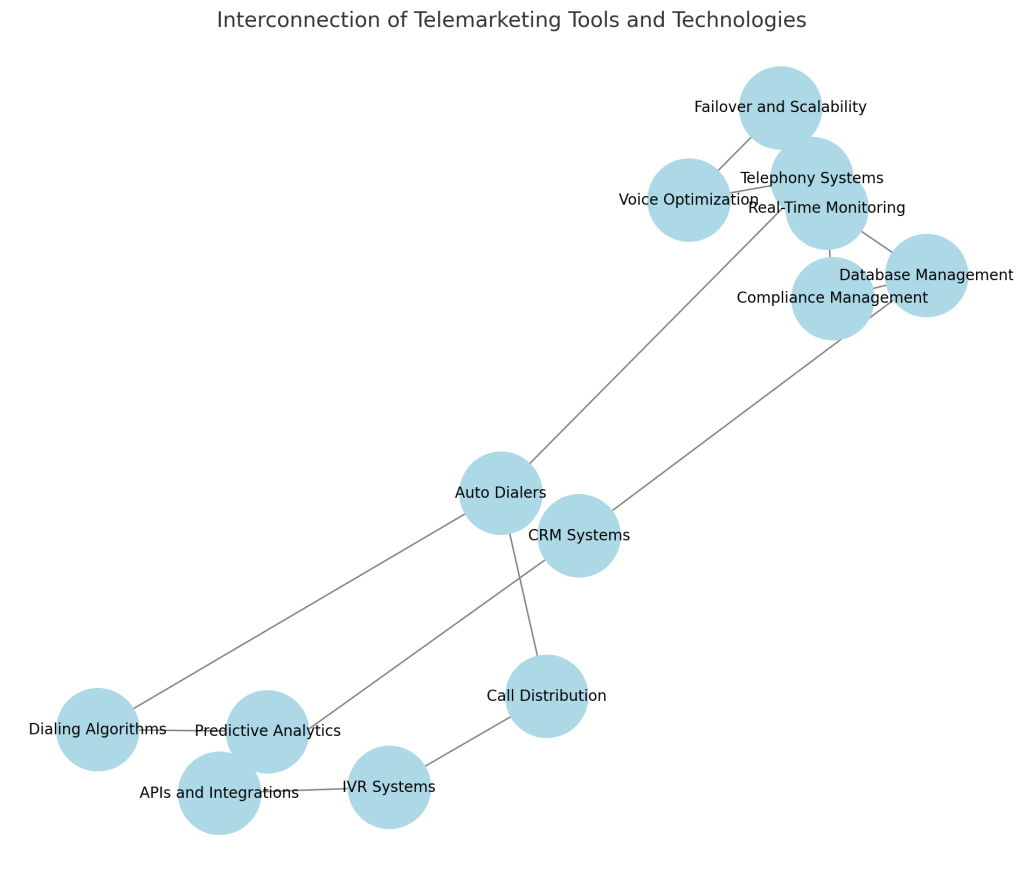
The diagram illustrates how various telemarketing tools and technologies are interconnected, showcasing their relationships and dependencies. Each node represents a technology, and the arrows indicate the flow of data or functionality between them
- Telephony Systems Integration
- Auto dialers integrate with telephony systems via Voice over IP (VoIP), PSTN (Public Switched Telephone Network), or hybrid models.
- VoIP enables calls over the internet, reducing costs and offering scalability.
- PSTN ensures reliability and compatibility with traditional phone networks.
- Dialing Algorithms
- The backend includes advanced algorithms that determine which numbers to dial and when, based on:
- Agent availability
- Historical call response rates
- Time zones and calling schedules
- The backend includes advanced algorithms that determine which numbers to dial and when, based on:
- Database Management
- Auto dialers connect to a backend database or CRM where customer or lead information is stored.
- They retrieve numbers, customer history, and other details in real time to personalize interactions.
- Call Distribution Mechanisms
- Backend systems route connected calls to the appropriate agent using Automatic Call Distribution (ACD) systems.
- ACDs ensure optimal load balancing by distributing calls based on agent skills, workload, and availability.
- Interactive Voice Response (IVR) Integration
- Many auto dialers work alongside IVR systems to handle pre-call routing or automate initial interactions.
- IVR backend uses DTMF (Dual-Tone Multi-Frequency) signals or speech recognition to guide customers through menus.
- APIs and Integrations
- Auto dialers integrate with third-party software (CRM systems, compliance tools, analytics platforms) through RESTful APIs or SOAP protocols.
- APIs enable seamless data exchange between systems for real-time updates and insights.
- Real-Time Monitoring and Reporting
- Backend systems capture call metrics, such as:
- Call duration
- Connection rates
- Agent performance
- Data is stored in databases like MySQL or PostgreSQL and visualized through tools like Tableau or Power BI.
- Backend systems capture call metrics, such as:
- Predictive Analytics
- Predictive dialers use machine learning models to forecast:
- Likelihood of call connection
- Agent availability
- Optimal dialing times
- These models are powered by frameworks like TensorFlow or Scikit-learn.
- Predictive dialers use machine learning models to forecast:
- Voice and Call Quality Optimization
- Systems optimize voice quality using protocols like SIP (Session Initiation Protocol) and RTP (Real-Time Transport Protocol) for packetized voice data over networks.
- QoS (Quality of Service) mechanisms prioritize voice traffic to reduce latency and packet loss.
- Compliance Management
- Auto dialers incorporate compliance logic to ensure adherence to regulations:
- Scrubbing numbers against Do Not Call (DNC) lists.
- Managing call timing to meet regional laws.
- This is often implemented through rule-based engines and real-time validation APIs.
- Auto dialers incorporate compliance logic to ensure adherence to regulations:
- Failover and Scalability
- High-availability (HA) architectures ensure uptime and reliability, with mechanisms for:
- Load balancing
- Failover between servers
- Backend systems are hosted on scalable infrastructure, often using cloud platforms like AWS or Azure.
- High-availability (HA) architectures ensure uptime and reliability, with mechanisms for:
The diagram illustrates how various telemarketing tools and technologies are interconnected, showcasing their relationships and dependencies. Each node represents a technology, and the arrows indicate the flow of data or functionality between them
Backend Workflow of an Auto Dialer
- Data Input:
- Import contact data from CRM or lead lists.
- Number Validation:
- Check numbers for validity, duplicates, and compliance (e.g., scrubbing against DNC lists).
- Dialing Algorithm:
- Determine the next number to dial based on predictive or preset logic.
- Call Initiation:
- Use VoIP or PSTN systems to establish a call.
- Call Connection:
- Route the call to an available agent or IVR system if answered.
- Real-Time Monitoring:
- Log call progress and agent activity in the backend.
- Post-Call Processing:
- Update customer records and prepare for follow-up actions.
Technologies Commonly Used in Auto Dialer Backend
- Programming Languages:
- Python, Java, C++, Node.js (for building and managing backend processes).
- Databases:
- SQL (MySQL, PostgreSQL) or NoSQL (MongoDB) for managing customer data.
- Cloud Services:
- AWS (Amazon Connect), Azure, or Google Cloud for scalability and integration.
- Telephony Protocols:
- SIP, RTP for VoIP communication.
- Middleware:
- Asterisk or FreePBX for call handling and routing.
By leveraging these backend technologies, auto dialers streamline telemarketing campaigns, reduce agent downtime, and ensure compliance, resulting in higher efficiency and better customer engagement.
]]>1. Service Provider Perspective
Objective: Build a reputation as a responsible and customer-centric telemarketing agency.
Strategies:
- Focus on Training:
- Provide comprehensive training to agents on communication skills, emotional intelligence, and product knowledge.
- Train agents to avoid high-pressure tactics and instead focus on understanding customer needs.
- Adopt Transparent Practices:
- Clearly disclose the purpose of calls and the organization being represented.
- Ensure calls are conducted ethically and respectfully, following all legal guidelines.
- Leverage Technology:
- Use advanced call filtering to avoid contacting numbers on the Do Not Call (DNC) list.
- Implement tools like Customer Relationship Management (CRM) software for personalized and targeted campaigns, reducing irrelevant calls.
- Create Value-Based Campaigns:
- Shift focus from aggressive sales to value-driven conversations, such as sharing useful information, special offers, or problem-solving.
- Build Trust:
- Encourage clients to participate in follow-ups for quality assurance.
- Use customer testimonials and transparent policies to improve brand perception.
2. Client Perspective
Objective: Position telemarketing as an effective and trustworthy part of the business strategy.
Strategies:
- Promote Value-Driven Campaigns:
- Emphasize how telemarketing campaigns benefit the target audience (e.g., exclusive discounts, personalized solutions).
- Integrate with Other Channels:
- Use telemarketing as part of an omnichannel strategy, complementing emails, SMS, and digital marketing to reduce over-reliance on cold calls.
- Maintain Data Privacy:
- Assure customers that their information is used responsibly and complies with data protection regulations like GDPR or TCPA.
- Monitor and Optimize:
- Regularly review call scripts, customer feedback, and conversion metrics to ensure high-quality interactions.
- Educate the Public:
- Share case studies and success stories to showcase the positive impact of telemarketing.
3. Target Customer Perspective
Objective: Shift customer perception from viewing telemarketing as intrusive to seeing it as valuable.
Strategies:
- Respect Customer Preferences:
- Avoid calling during inappropriate hours.
- Honor opt-out requests promptly and ensure no further contact unless invited.
- Make Calls Relevant:
- Use targeted approaches by understanding customer demographics, preferences, and previous interactions.
- Avoid generic pitches; instead, tailor messages to offer solutions that resonate with the recipient.
- Be Transparent and Honest:
- Clearly state who is calling, why, and how the customer can benefit.
- Avoid misleading or overly promotional language.
- Build Relationships, Not Just Sales:
- Focus on long-term customer relationships by providing genuine assistance, even if it doesn’t result in an immediate sale.
- Encourage Feedback:
- Actively ask customers how the interaction could be improved.
- Use feedback to adjust scripts and approaches for better engagement.
4. Industry-Wide Perspective
Objective: Rebuild the broader image of telemarketing through collective efforts.
Strategies:
- Adopt a Code of Ethics:
- Industry associations can create and promote a standard code of conduct for telemarketing companies.
- Promote Positive Stories:
- Highlight success stories where telemarketing provided significant value to customers.
- Raise Awareness:
- Educate the public about their rights, such as opting out or filing complaints against bad practices.
- Share how telemarketing contributes to jobs and economic activity.
- Combat Spam Calls:
- Work with regulators to curb robocalls and call spoofing, which are major contributors to the negative image.
Outcome Goals
- From Service Provider & Client Perspective:
- Improved reputation and customer trust.
- Higher quality leads and better conversion rates.
- Reduced legal and reputational risks.
- From Target Customer Perspective:
- A sense of being respected and valued.
- Positive interactions that are more likely to lead to engagement or purchases.
- Reduced frustration with irrelevant or intrusive calls.
By aligning the interests of all stakeholders and committing to ethical, customer-centric practices, telemarketing can overcome its negative perception and establish itself as a valuable tool in the marketing ecosystem.
]]>Telemarketing remains a vital channel for businesses aiming to connect directly with potential customers and grow their market presence. However, the landscape for telemarketing in the United States is tightly regulated by a complex framework of federal laws, state regulations, and industry best practices. This article provides an in-depth exploration of these rules, the rights of consumers, enforcement mechanisms, and evolving trends shaping telemarketing today. Whether you’re a telemarketing professional, business owner, or compliance officer, understanding this landscape is crucial to ensuring effective and lawful telemarketing campaigns.
1. Introduction to Telemarketing Regulation in the USA
Telemarketing involves using phone calls, SMS, and other direct communication methods to promote products, services, or solicit donations. The proliferation of unsolicited calls—particularly robocalls and spam messages—has prompted robust regulatory responses designed to protect consumer privacy and prevent abusive practices.
At the federal level, key laws include the Telephone Consumer Protection Act (TCPA) and the Telemarketing Sales Rule (TSR), while the National Do Not Call Registry provides a mechanism for consumers to opt out of unwanted calls. Additionally, state laws may impose stricter rules than federal ones, making compliance a multi-layered challenge for telemarketers.
2. Key Federal Laws Governing Telemarketing
2.1 Telephone Consumer Protection Act (TCPA)
Enacted in 1991, the Telephone Consumer Protection Act was one of the first laws to regulate telemarketing calls, particularly focusing on automated calls and texts. The TCPA restricts how telemarketers can contact consumers by phone and SMS, especially regarding:
-
Robocalls and Automated Dialers: The TCPA prohibits making unsolicited calls or sending texts using automated telephone dialing systems (auto-dialers) or pre-recorded messages unless the recipient has given prior express written consent.
-
Prior Consent Requirement: Telemarketers must obtain explicit permission from consumers before contacting them with automated calls or texts for telemarketing purposes. This written consent must be clear and documented.
-
Restrictions on Cell Phones: The TCPA also restricts marketing calls and texts to wireless numbers unless prior consent is given, reflecting the higher privacy concerns with mobile devices.
-
Opt-Out Mechanisms: Consumers must be provided an easy, automated way to opt out of future communications during robocalls or text campaigns.
Violations of the TCPA carry heavy penalties, with fines up to $500 per unsolicited call or text, which can triple to $1,500 if the violation is willful or knowing.
2.2 Telemarketing Sales Rule (TSR)
The Telemarketing Sales Rule is enforced by the Federal Trade Commission (FTC) and is designed to prohibit deceptive or abusive telemarketing practices. Key provisions include:
-
Prohibition of Misleading Practices: Telemarketers cannot make false statements about products or services, misrepresent their identity, or use high-pressure tactics to coerce consumers.
-
Mandatory Disclosures: Telemarketers must disclose essential information at the beginning of the call, such as their identity, the purpose of the call, and the price or material terms of any offer.
-
Restrictions on Payment Methods: The TSR restricts certain payment methods for telemarketing transactions to prevent fraud.
-
Abuse Prevention: The TSR bars telemarketers from engaging in harassing or abusive behavior, such as calling repeatedly or using threatening language.
Violations of the TSR can result in significant fines and legal actions from the FTC.
2.3 National Do Not Call Registry
Managed by the FTC, the National Do Not Call Registry allows consumers to opt out of receiving unsolicited telemarketing calls. Key features:
-
Consumer Opt-Out: Individuals can add their phone numbers to the registry to stop most telemarketing calls.
-
Mandatory Compliance: Telemarketers must check the registry at least once every 31 days and remove any listed numbers from their call lists.
-
Exceptions: Certain types of calls are exempt from the registry rules, including calls from charities, political organizations, surveyors, and companies with an established business relationship with the consumer.
Failure to comply with the Do Not Call rules can result in hefty fines.
3. State-Level Regulations
Beyond federal laws, many states have implemented their own telemarketing laws that may impose stricter rules. These can include:
-
Additional state do-not-call lists.
-
Limitations on permissible calling hours beyond the federal standards.
-
Requirements for telemarketer registration or bonding.
-
Specific rules on recording calls or disclosing the purpose of the call.
For example, states like California and Florida have tougher rules regarding telemarketing calls and higher penalties for violations. Businesses operating nationally need to be aware of and comply with these varying state laws in addition to federal requirements.
4. Permissible Calling Hours in the USA
The federal rules specify that telemarketing calls may only be made between 8:00 AM and 9:00 PM local time of the recipient. This restriction helps protect consumers from intrusive calls during early morning or late evening hours. State laws may further restrict calling times.
5. Consumer Rights and Protections
5.1 Opt-Out Requests
Consumers have the right to request that telemarketers stop calling them. Telemarketers are legally obligated to honor such requests within 30 days of receipt. Consumers may also opt out verbally during a call by requesting no further contact, which must be respected.
5.2 Disclosure Requirements
At the start of every telemarketing call, the caller must disclose:
-
Their name.
-
The company they represent.
-
The purpose of the call.
This transparency helps consumers make informed decisions about whether to engage with the caller.
5.3 Protection Against Harassment
The law strictly prohibits harassing or abusive behavior during telemarketing calls. This includes repeated calls with the intent to annoy, threaten, or intimidate consumers.
6. Penalties for Non-Compliance
Telemarketing violations can carry significant legal and financial consequences, including:
-
FTC Fines: Businesses may face fines up to $43,792 per violation of the Telemarketing Sales Rule.
-
TCPA Civil Lawsuits: Consumers can sue violators for damages ranging from $500 to $1,500 per unwanted call or text, providing a strong deterrent.
-
Class Action Lawsuits: Companies with large volumes of illegal calls may face class-action suits with substantial settlements.
Due to these risks, compliance is not just ethical but essential to avoid costly litigation and reputational damage.
7. Current Trends in Telemarketing in the USA
7.1 Increased Regulation of Robocalls
Robocalls—automated calls delivering prerecorded messages—have become a major source of consumer complaints. The FCC has implemented frameworks like STIR/SHAKEN to authenticate caller ID information and reduce call spoofing, where scammers disguise their numbers.
7.2 Shift to Omnichannel Marketing
Many businesses are moving beyond phone calls alone, integrating telemarketing with email, social media, and SMS to create a cohesive customer outreach strategy. This omnichannel approach allows companies to engage customers on their preferred platforms and improves response rates.
7.3 Emphasis on Ethical Practices
With rising public awareness and scrutiny, companies are prioritizing ethical telemarketing. This includes respecting consumer preferences, avoiding pressure tactics, and maintaining transparency to build trust.
7.4 Growth of B2B Telemarketing
Business-to-business (B2B) telemarketing remains robust, focusing on lead generation, appointment setting, and account-based marketing. The B2B space tends to face fewer regulatory restrictions but still adheres to best practices around consent and transparency.
8. Best Practices for Telemarketing Compliance and Effectiveness
8.1 Compliance First
-
Regularly update telemarketing lists against the National Do Not Call Registry.
-
Stay informed about federal and state laws affecting telemarketing.
-
Train agents thoroughly on legal requirements and ethical communication.
8.2 Use Technology to Improve Efficiency
-
Employ Customer Relationship Management (CRM) tools to manage leads and consent records.
-
Implement call monitoring and analytics systems to ensure compliance and improve call quality.
-
Use automated opt-out and preference management solutions to honor consumer requests quickly.
8.3 Targeted Campaigns
-
Focus on pre-qualified leads or individuals who have expressed interest in your products or services.
-
Avoid random “cold” calling, which tends to yield low conversion rates and high complaints.
8.4 Transparency and Respect
-
Clearly explain the purpose of the call.
-
Avoid using high-pressure sales tactics.
-
Respect consumer preferences for communication channels, offering options like email or SMS when appropriate.
8.5 Adapt to Changing Consumer Preferences
-
Monitor evolving consumer communication preferences.
-
Provide flexible options for engagement that respect privacy and convenience.
9. Conclusion
Telemarketing in the USA is governed by a detailed framework of laws designed to protect consumers while allowing businesses to engage effectively. The Telephone Consumer Protection Act (TCPA), the Telemarketing Sales Rule (TSR), the National Do Not Call Registry, and state regulations collectively establish strict rules about how and when telemarketers can contact individuals.
By understanding these legal requirements and implementing best practices—such as compliance training, using technology wisely, targeting qualified leads, and maintaining transparency—businesses can build trust, avoid legal pitfalls, and improve the effectiveness of their telemarketing campaigns.
With evolving regulations and rising consumer expectations, telemarketers must prioritize ethical practices and adapt to new trends like omnichannel marketing. In doing so, they not only comply with the law but also create sustainable, respectful relationships with customers that drive long-term success.
]]>This comprehensive article explores the core concepts of telemarketing, its types, benefits, challenges, best practices, and real-world applications to help marketers and business leaders optimize their campaigns for maximum success.
What Is Telemarketing?
Telemarketing is a form of direct marketing where sales representatives reach out to potential or existing customers by phone. The primary objective is to promote products or services, conduct surveys, collect customer information, or provide support. It is an essential channel for businesses aiming to establish immediate, personalized communication with their audience.
Types of Telemarketing
Understanding the different types of telemarketing is crucial for developing targeted and effective campaigns. The main types include:
1. Outbound Telemarketing
In outbound telemarketing, sales representatives initiate calls to potential customers. These calls are often used for:
-
Lead Generation: Identifying and qualifying potential customers.
-
Cold Calling: Reaching out to individuals who have no prior relationship with the business.
-
Appointment Setting: Scheduling meetings or product demonstrations.
-
Direct Sales: Closing sales over the phone.
Example: A software company calling small businesses to offer a free trial of their new CRM software.
2. Inbound Telemarketing
Inbound telemarketing occurs when customers call the business, usually in response to advertisements, promotions, or other marketing efforts. These calls typically focus on:
-
Order Processing: Taking customer orders over the phone.
-
Customer Service: Handling inquiries, complaints, or technical support.
-
Information Requests: Providing details about products or services.
Example: A retail store running a TV ad with a hotline number for customers to place orders or ask about sales.
3. Business-to-Business (B2B) Telemarketing
B2B telemarketing involves calls made to other businesses. It requires specialized knowledge about the industry, products, and business needs. B2B telemarketing can be used to:
-
Promote products or services tailored to businesses.
-
Generate leads for sales teams.
-
Set up appointments for business negotiations.
Example: A logistics company calling manufacturers to offer freight shipping solutions.
4. Business-to-Consumer (B2C) Telemarketing
B2C telemarketing targets individual consumers, typically to promote retail products, services, or subscriptions. The approach is generally more volume-based, aiming to reach a large number of prospects.
Example: A telecom provider calling residential customers to offer discounted internet packages.
Advantages of Telemarketing
Despite challenges, telemarketing offers several distinct advantages:
1. Direct Interaction
Telemarketing provides a personal and immediate way to connect with customers. Unlike emails or social media, phone calls allow for real-time conversations where sales reps can address objections and build rapport.
2. Immediate Feedback
Sales representatives can gauge customer interest, clarify doubts, and adapt their pitch based on the conversation. This direct feedback loop is invaluable for refining marketing strategies.
3. Cost-Effectiveness
Compared to traditional advertising methods such as print or TV, telemarketing campaigns can be more affordable and easier to track in terms of ROI.
4. Scalability
Telemarketing campaigns can quickly scale up or down based on performance data, allowing businesses to allocate resources more efficiently.
5. Versatility
Telemarketing is not just about selling; it can be used for lead nurturing, market research, appointment setting, surveys, and customer retention.
Challenges of Telemarketing
Telemarketing also faces significant hurdles that businesses must navigate carefully:
1. Regulatory Compliance
Many countries have strict laws regulating telemarketing, including the Do Not Call (DNC) registry in the U.S. and the General Data Protection Regulation (GDPR) in the EU. Violating these can lead to heavy fines and damage to brand reputation.
2. Negative Perception
Many consumers perceive telemarketing as intrusive or annoying, especially when calls are unsolicited or repetitive.
3. High Rejection Rates
Cold calling often results in a high percentage of rejections, making telemarketing a challenging and sometimes demotivating job.
4. Technological Barriers
The rise of caller ID, call blocking, and spam filters has made it harder for telemarketers to reach potential customers.
Best Practices in Telemarketing
To maximize effectiveness while minimizing downsides, businesses should follow these best practices:
Compliance and Respect for Privacy
-
Always check and respect Do Not Call lists.
-
Obtain necessary permissions before calling.
-
Stay updated on local and international telemarketing laws.
-
Be transparent about the caller’s identity and purpose.
Comprehensive Training
-
Train telemarketers on product knowledge, communication skills, and objection handling.
-
Use role-playing scenarios to build confidence.
-
Teach emotional intelligence and active listening to build trust.
Targeted Lists and Segmentation
-
Use data-driven approaches to segment your audience.
-
Focus on qualified leads rather than random calls.
-
Personalize calls based on customer data and history.
Focus on Quality, Not Quantity
-
Prioritize meaningful conversations over sheer call volume.
-
Use CRM tools to track interactions and customer preferences.
-
Develop scripts that sound natural and customer-centric.
Respect Customer Time and Preferences
-
Avoid calling at inconvenient times.
-
Ask for permission to continue the conversation.
-
Accept rejection gracefully and offer opt-out options.
Effective Follow-Up
-
Record key details from calls.
-
Schedule timely follow-ups to nurture leads.
-
Use telemarketing as part of a multi-channel strategy, integrating with email and digital marketing.
Use Cases and Examples
Telemarketing has a broad range of applications across industries. Here are some specific use cases illustrating how businesses leverage telemarketing effectively:
1. Lead Generation for Software Companies
A SaaS company uses outbound telemarketing to reach IT managers in mid-sized companies. The reps offer a free product demo, addressing specific pain points like workflow automation. The personal call helps warm up leads before handing them over to the sales team.
2. Customer Retention in Subscription Services
A fitness club calls existing members approaching their subscription renewal date. The telemarketer offers discounted renewal rates and new class options, reducing churn and enhancing member loyalty.
3. Market Research for Consumer Goods
A consumer electronics firm runs outbound calls to gather opinions on new product features and price sensitivity. This real-time feedback guides product development and marketing messaging.
4. Appointment Setting for Financial Advisors
Financial firms use telemarketing to set up face-to-face or virtual meetings with high-net-worth individuals. Calls are scripted to build credibility and explain the advisor’s value proposition.
5. Inbound Telemarketing for Retailers
Retail chains run ad campaigns with a dedicated phone line for ordering during promotional periods. Customer service reps handle inquiries and orders, improving customer experience and sales during peak times.
Telemarketing in the Digital Age
While telemarketing is traditionally phone-based, integrating it with modern technologies can significantly enhance its impact:
1. CRM Integration
Using Customer Relationship Management (CRM) tools helps telemarketers track every interaction, customer preference, and purchase history, enabling personalized calls and better follow-up.
2. Automated Dialers and Predictive Dialing
Automated dialers can increase call efficiency by connecting reps to live calls faster and screening out answering machines. Predictive dialing systems analyze data to optimize call times and maximize connect rates.
3. Multi-Channel Campaigns
Combining telemarketing with email marketing, SMS, and social media outreach creates cohesive campaigns. For example, an email might warm up leads before a telemarketing call, or a follow-up SMS might confirm an appointment.
4. AI and Chatbots
Artificial intelligence can assist in scripting, sentiment analysis, and lead scoring. Chatbots handle simple queries via web or text, allowing telemarketers to focus on high-value interactions.
Case Study: How Telemarketing Boosted Sales for an Insurance Company
An insurance provider struggled with low inbound inquiries and needed to generate qualified leads for its retirement plans. They implemented an outbound telemarketing campaign targeting individuals aged 45-65.
-
Strategy: Calls were made during early evenings; telemarketers were trained extensively on retirement benefits.
-
Tools: CRM integration helped tailor conversations based on previous inquiries.
-
Outcome: The campaign resulted in a 25% increase in qualified leads and a 15% rise in sales over six months.
-
Lessons: Targeting, timing, and training were key factors in the campaign’s success.
Future of Telemarketing
The future of telemarketing lies in balancing technology with the human touch. As regulations tighten and consumer preferences evolve, telemarketing must become smarter, more respectful, and integrated with digital channels.
-
Voice Recognition & AI: Enhanced AI tools will allow more natural conversations and better lead qualification.
-
Personalization at Scale: Using big data, companies can tailor offers uniquely for each customer.
-
Compliance Automation: Tools will help monitor and ensure strict adherence to legal requirements.
-
Hybrid Models: Telemarketing combined with video calls and digital presentations could provide richer customer experiences.
Conclusion
Telemarketing remains a valuable strategy in the marketer’s toolkit. When executed correctly, it delivers direct engagement, valuable customer insights, and measurable sales impact. Success depends on respecting regulations, training teams well, targeting the right audience, and focusing on quality conversations over call quantity.
By embracing new technologies and integrating telemarketing with broader marketing efforts, businesses can continue to harness this powerful channel in an increasingly digital world.
Whether you need expert telemarketing setup or want to hire top-notch telemarketers, we’ve got you covered. Get in touch today and watch your sales soar!
]]>