Model Context Protocol (MCP) Deep Dive: Unlocking the Future of AI Integration
Artificial intelligence is no longer a futuristic concept-it’s the new digital backbone of industries across the globe. But as AI becomes smarter, the infrastructure required to connect it to the real world grows more complex. Developers, product teams, and enterprises alike are facing an explosion of tools, APIs, and data sources that don’t speak the same language. Enter the Model Context Protocol (MCP): a groundbreaking open standard designed to simplify and unify the way AI systems interact with external services.
Pioneered by Anthropic, MCP offers a plug-and-play framework that lets large language models (LLMs) like Claude or GPT seamlessly connect to live systems-be it Google Drive, GitHub, customer databases, or supply chain APIs. It’s being hailed as the USB-C for AI: one protocol to bridge models, tools, and services in real time, securely and scalably.
Nowhere is the need for such integration more urgent-or the opportunity greater-than in California. From the innovation hubs of Silicon Valley to the creative engines of Hollywood and the logistics corridors of Long Beach, businesses across the Golden State are leveraging AI like never before. But without a streamlined way to connect these powerful models to live tools and data, their potential remains bottlenecked.
In this article, we’ll take a deep dive into how the Model Context Protocol works, why it matters, and why California’s tech, media, e-commerce, and healthcare leaders are perfectly positioned to capitalize on its transformative capabilities.
What is Model Context Protocol (MCP) and Why It Matters
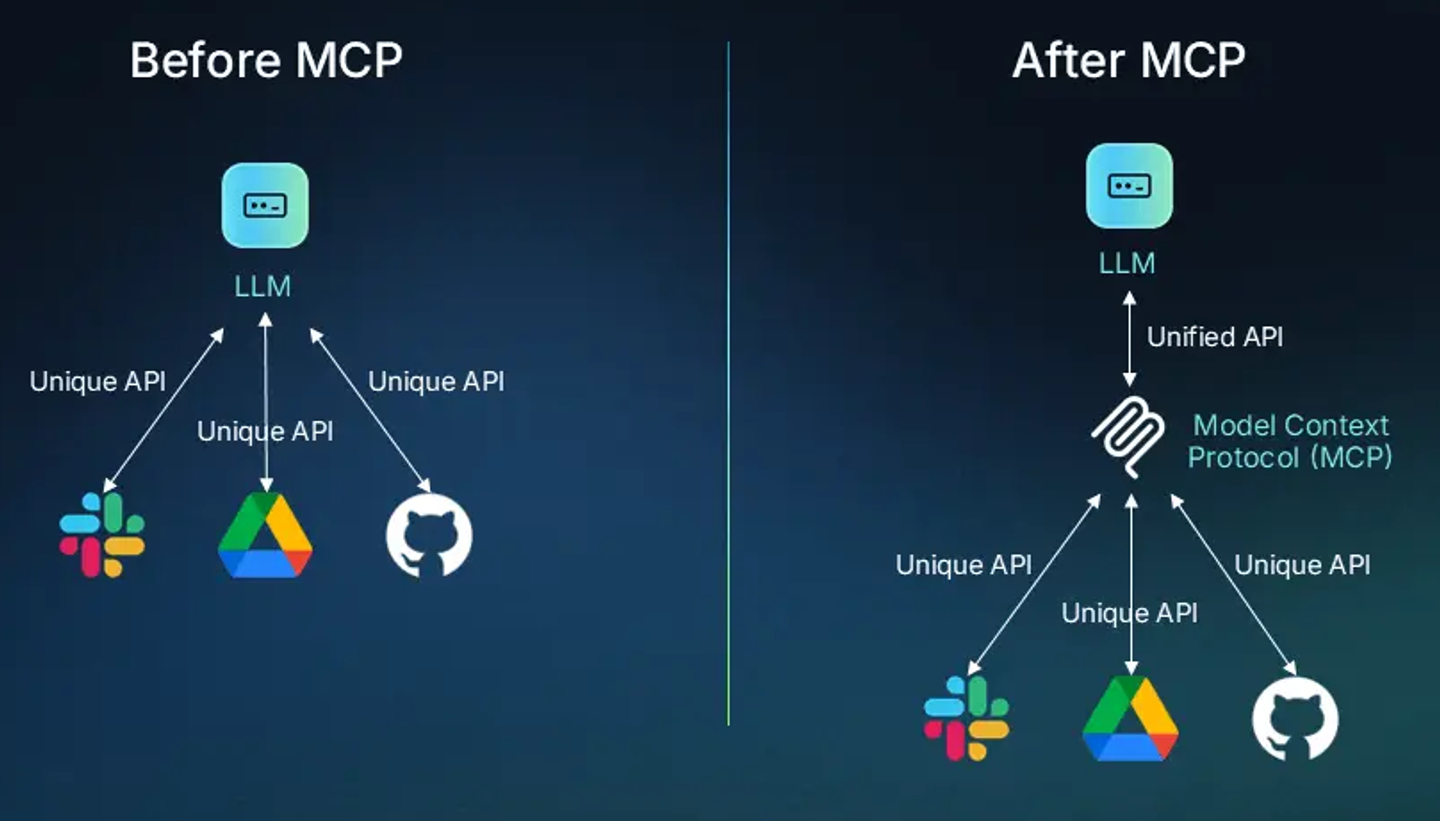
A Standard, Not a Tool – The Model Context Protocol is not a standalone tool. It’s a protocol; a set of rules and structures that define how AI systems discover and interact with external tools, services, and context. Its role is foundational, enabling AI applications to perform real-time actions and queries in a consistent, scalable manner. Solving the “Integration Mess – Prior to MCP, developers faced the N x M problem: connecting N AI applications to M external systems meant building and maintaining NxM custom integrations. Each connection required unique code, authentication handling, and maintenance logic. The result? Brittle systems, inconsistent performance, and painful scaling. MCP simplifies this dramatically with a universal interface. The USB-C Analogy – Much like USB-C standardized hardware connectivity across devices, MCP standardizes AI’s connection to tools and data sources. Instead of bespoke integration layers for every tool, developers can build or plug into MCP servers that handle the complexity, allowing AI applications to use tools interchangeably and dynamically. Empowering LLMs – LLMs like Claude or GPT are powerful but fundamentally limited; they can only generate responses based on static training data and lack real-time, contextual awareness. With MCP, these models can now interact with live systems; retrieving inventory from an e-commerce API, querying GitHub commits, sending emails via Gmail, and more. Benefits at a Glance
- Custom Integrations: Build once, deploy everywhere. Easily integrate Slack, Google Drive, or any other tool into an MCP-enabled application.
- Portable Tool Sets: Create and share reusable prompt templates, tool definitions, and workflows across IDEs and apps.
- Rich Ecosystem: Leverage community-built MCP servers for instant access to a growing library of tools.
- Simplified Development: Both seasoned developers and no-code users benefit from easier integrations and less brittle systems.
🚀 Ready to connect your AI to the real world—fast?
Get up and running in days, not weeks. The Model Context Protocol Integration Starter Kit gives your team a plug-and-play setup with pre-configured tools, servers, and LLM access.
👉 Get the Starter Kit →
MCP Architecture and Core Components
At the heart of MCP is a client-server architecture, composed of four key layers:
- MCP Host: The top-level AI application (e.g., Claude Desktop, a web-based AI IDE, or a chatbot interface). The host is where the user interacts with the AI and where the experience lives.
- MCP Client: Embedded within the host, the MCP client is responsible for:
- Initiating requests to MCP servers.
- Discovering server capabilities (tools, resources, templates).
- Sending tool execution requests and processing responses.
- MCP Server: A standalone service or lightweight program that handles all communication with external systems. Responsibilities include:
- Listening for tool or resource requests.
- Executing the logic (e.g., making API calls or querying databases).
- Sending structured responses back to the client.
- External Systems: These are the actual services or data sources; Slack, GitHub, MySQL, Google Maps, local files, cloud storage; that MCP servers connect to. They are the endpoints of action and data retrieval.
🤖 Want your AI to do, not just talk?
The LLM Agent-in-a-Box builds a fully operational AI agent using real-time data via MCP. Automate workflows across ops, support, or custom tasks.
👉 Deploy Your Agent →
MCP Primitives: Tools, Resources, and Templates
Tools : Tools are executable functions exposed by MCP servers. They allow AI models to perform actions via natural language prompts. Each tool is defined with parameters (using schemas like Zod) and metadata. The actual execution happens on the server, not in the AI model, reinforcing security and modularity. Example use cases:
- list_commits on GitHub
- get_inventory on an e-commerce platform
- purchase_item from a cart
- create_email_draft in Gmail
Resources: Resources provide read-only access to structured data or files. Resources are efficient and ideal for frequently accessed, low-latency data. Think of them as simplified APIs for retrieving static or lightly dynamic data:
- Email templates
- Contact lists
- Order histories
Prompt Templates: Prompt templates are boilerplate prompts designed to give LLMs consistent instructions. These templates improve consistency, reduce prompt length, and encourage optimal tool usage.. They support personalization by including placeholders (like user name, role, current task):
- “You are a customer support agent. Please reply politely…”
- “Here is the JSON from the orders API…
How Model Context Protocol Works: The Workflow
Let’s break down a typical interaction between a user, an LLM, an MCP client, and a server. All of this occurs in real-time, often in milliseconds, and the user sees only the final output. Step-by-Step Flow
- Discover Capabilities: On startup, the MCP client queries its connected servers and retrieves a list of available tools and resources.
- User Query: The user asks something like “Show me the last 3 GitHub commits.”
- LLM Input: The AI model receives the prompt along with tool metadata and prompt templates.
- Determine Tool Use: The LLM decides which tool(s) are needed and which parameters to use.
- Execute Tool: The client calls the appropriate tool on the MCP server.
- External Interaction: The server performs the action; e.g., hitting a GitHub API.
- Return Results: The data is sent back to the client.
- Context Injection: The client passes the new data back to the LLM.
- Final Response: The LLM uses this enriched context to provide a final, accurate answer.
Transport Mechanisms: How Clients and Servers Communicate
MCP supports two primary communication methods:
- Standard IO: Ideal for local development. The server runs as a subprocess, and the client communicates via standard input/output streams. This is fast, simple, and secure for local workflows.
- HTTP with Server-Sent Events (SSE): Perfect for remote or cloud-deployed servers. Clients communicate with the server over HTTPS, and SSE provides a stateful, event-driven architecture. This enables live updates and real-time interactions across distributed systems.
⚙️ Want to put Model Context Protocol’s communication model into action?
Build and deploy real-world AI agents that speak directly with your tools, APIs, and users.
The LLM Agent-in-a-Box uses MCP’s transport methods (StdIO or SSE) to create reliable, event-driven workflows—ready for your ops, support, or internal tooling.
👉 Launch Your AI Agent →
Real-World Implementations and Use Cases
- Anthropic and Claude: has tightly integrated MCP into Claude Desktop, providing native client support. Claude can connect to any MCP-compatible server, enabling rich real-time capabilities.
- SDKs and Templates: Official SDKs in Python and other languages make it easy to build custom servers. Reference implementations exist for Google Drive, GitHub, Gmail, local file systems, PostgreSQL, and more.
- Cursor & Windsurf IDEs: These advanced IDEs include MCP support, enabling developers to run agent workflows, access backend tools, and even automate development tasks using AI agents.
- E-commerce Demo: In a demo setup, an AI assistant uses MCP to interact with two separate APIs, This shows how MCP can empower AI to be a full-fledged retail assistant.:
- Product API for recommendations
- Fulfillment API to place and track orders
- Business Intelligence with Claude: Claude connects via standard IO to an MCP server exposing order data. It can summarize trends, identify anomalies, and generate visual charts; thanks to code execution enabled by MCP.
Client Tools vs. Server Tools
- Server Tools: The default and preferred use case. Server tools have access to secure, robust backends and handle core business logic (e.g., financial APIs, databases).
- Client Tools: Used for interactions with client-only resources (like GPS or local cache). While not MCP’s primary strength, client tools may be supported in future iterations. Important distinction: “Model Context Protocol is designed for server tools, not client tools.”
🧠 Have an idea but not the dev team?
The MCP Prototype Builder helps founders turn AI product ideas into live prototypes using MCP—in just weeks.
👉 Build Your MVP →
Configuration and Deployment
Connecting an AI app to an MCP server requires editing a configuration file (usually JSON or YAML). This approach ensures portable, reproducible, and secure integrations. This file includes:
- Server name and command
- Startup arguments
- Connection method (Standard IO or HTTP)
- Tool/resource definitions
Future Outlook: AI Orchestration at Scale
The future of AI depends not just on smarter models; but on smarter integrations. MCP represents the foundation for agentic AI workflows, enabling models to:
- Retrieve real-time context
- Execute multi-step tasks autonomously
- Act as full agents in complex digital ecosystems
As the ecosystem of MCP clients and servers grows, we can expect:
- Widespread interoperability between tools and models
- Community-driven innovation with open-source servers
- Enhanced security and auditability for AI actions
- Reduced development time and increased reliability
In essence, Model Context Protocol isn’t just a protocol; it’s the nervous system for integrated, intelligent, and actionable AI. The Model Context Protocol is more than just an engineering solution; it’s a strategic breakthrough. By transforming the way AI applications interact with tools and data, MCP positions itself as the backbone of the next generation of AI development. With strong backing from Anthropic and growing community support, MCP is poised to become the standard that finally unifies AI capability with real-world functionality. Whether you’re building the next AI-powered IDE, chatbot, or business assistant, MCP is the key to unlocking true intelligence; and usefulness.
How companies in California especially those in tech, e-commerce, SaaS, and media- can benefit from this?
1. Streamlined AI Integration Across Diverse Tools
California firms often rely on a diverse tech stack: Slack, Salesforce, Google Workspace, custom APIs, internal databases, etc. MCP allows seamless integration with these tools via standardized, reusable interfaces-reducing the need for bespoke code for every connection.
- Example: A Bay Area startup can plug an LLM into their GitHub repos, CRM, and product database using one MCP-compatible layer-dramatically lowering engineering overhead.
2. Faster AI Product Prototyping
Companies building AI-enabled products (e.g., productivity apps, development tools, voice assistants) can use MCP’s ready-made toolkits and reference servers to prototype faster.
- Example: A Los Angeles SaaS company could quickly integrate real-time Google Drive or Gmail access into their AI assistant by using an existing MCP server, skipping months of custom backend work.
3. Competitive Edge in Agentic Workflows
With MCP, businesses can move from passive AI (e.g., summarizing emails) to agentic AI (e.g., drafting, organizing, and even sending follow-up emails). This enables autonomous workflows that save time and reduce human involvement in repetitive tasks.
- Example: A San Diego marketing agency could have an LLM that accesses campaign data, prepares performance reports, and updates project tracking tools autonomously.
4. Scalability for AI Startups
Silicon Valley AI startups can leverage MCP to scale integrations without bloating engineering teams. By using MCP clients and contributing to or consuming from the open-source MCP server ecosystem, companies avoid the integration bottleneck entirely.
- Benefit: Build once, deploy anywhere. A tool built for Claude can also work in Cursor, IDEs, or browser extensions-without re-implementation.
5. Improved Data Governance and Compliance
California companies are subject to strict data privacy laws (e.g., CCPA). MCP’s separation of the AI host, client, and server enables fine-grained control over which systems are exposed and how data is accessed-key for privacy-conscious enterprises.
- Example: A healthcare startup in Palo Alto can set up a HIPAA-compliant MCP server that allows only controlled access to anonymized patient records for internal AI analytics.
6. Ecosystem Participation & Innovation
Being at the forefront of AI, California companies can both contribute to and benefit from the open MCP ecosystem-developing custom servers, reusable tools, or even launching developer platforms.
- Example: A cloud services provider could build premium MCP servers for database, analytics, or e-commerce integrations-monetizing them as part of a developer SDK.
California Use Cases : MCP in Motion -Transforming California’s Core Industries with Intelligent AI Integration
California’s unique concentration of tech innovation, creative industries, and global logistics operations makes it a natural proving ground for the Model Context Protocol (MCP). From San Francisco’s fintech disruptors to Hollywood’s production powerhouses and the state’s massive logistics hubs, MCP offers a powerful framework to modernize workflows, unlock data-driven automation, and accelerate innovation. Here’s how MCP is reshaping core California industries:
1. Fintech: Automating Compliance and Customer Insights
Fintech startups and digital banking platforms in California operate in a highly regulated environment where real-time data access and strict compliance are non-negotiable. MCP allows these companies to build LLM-driven assistants that can securely access and analyze customer records, transaction histories, and regulatory documents across multiple systems.
- Example:A San Francisco-based digital bank uses an MCP server connected to a financial transaction API and KYC (Know Your Customer) database. An LLM-powered chatbot, integrated via MCP, assists compliance officers by automatically flagging suspicious transactions, cross-referencing them with historical data, and summarizing key risk indicators-reducing manual review time by over 70%.
2. Entertainment: Empowering Creative Pipelines with AI Agents
California’s entertainment sector-from Hollywood studios to content platforms and gaming companies-is ripe for automation across production, post-production, and marketing. MCP empowers creative professionals to use AI agents that directly interact with asset libraries, project management systems, and social media platforms.
- Example:A Los Angeles-based video production studio integrates Claude Desktop (with MCP client) into their workflow. It connects to an MCP server accessing Adobe Creative Cloud files and a content calendar API. The AI assistant helps producers by summarizing project briefs, generating post captions for each release, and organizing footage metadata-all in real time.
3. Logistics and Supply Chain: Smarter Inventory and Dispatch
California’s ports, warehouses, and freight networks support a massive share of national and international logistics. Companies in this space juggle legacy systems, real-time tracking APIs, and supplier databases. MCP brings all this together under a unified protocol, enabling AI agents to optimize operations at scale.
- Example:A Long Beach logistics firm configures an MCP server to connect with their fleet tracking software, inventory database, and customer portal API. A custom AI tool built on top of this setup autonomously updates delivery ETAs, flags low-stock items, and responds to common customer inquiries without human intervention.
4. SaaS & Developer Tools: Portable AI Features for Rapid Scaling
SaaS companies across California, especially those in the Bay Area, are racing to embed AI features into their products. MCP allows them to build once and deploy across multiple environments-turning LLM interactions into fully modular, reusable workflows.
- Example:A developer tool startup in Palo Alto builds an MCP-compatible server to expose GitHub repo data and cloud build logs. By integrating it with multiple AI development tools like Cursor and Claude, users can get inline code reviews, commit summaries, and bug triage suggestions no matter what IDE they’re using.
5. E-commerce: Personalization and Fulfillment at Scale
Retail and e-commerce platforms operating in California need real-time access to product catalogs, user data, and fulfillment systems to deliver personalized customer experiences. MCP enables dynamic integration with these systems, transforming AI from a reactive assistant to a proactive agent.
Example:An Irvine-based DTC brand connects an MCP server to its product database and third-party logistics provider. A website chatbot running an LLM with MCP can handle complex queries like “Find me a waterproof jacket in my size under $150,” place orders, and even track shipping-all without writing new code for each service integration.
6. Healthcare & Biotech: Research and Patient Support Assistants
In California’s booming biotech and healthcare sectors, MCP offers a compliant and modular way to connect AI assistants to research databases, electronic health records, and diagnostic tools-helping scientists and providers do more, faster.
- Example:A San Diego biotech company builds a secure MCP server with access to PubMed, lab result repositories, and internal research papers. A Claude-powered assistant helps researchers formulate hypotheses, summarize relevant studies, and flag novel correlations in test results.
🛡️ Need AI integrations that check the legal boxes?
Our Compliance-Friendly MCP Setup ensures your workflows meet standards like HIPAA and CCPA—perfect for healthcare, fintech, and legal AI use.
👉 Secure Your AI Stack →
The Bigger Picture: California as the MCP Innovation Hub
Given its density of AI startups, cloud infrastructure providers, and enterprise adopters, California is poised to lead the way in building the next generation of intelligent, integrated AI systems. By embracing MCP early, local companies not only streamline internal operations but also contribute to and shape the evolving open-source ecosystem-positioning themselves as pioneers in the AI integration revolution.
Sources:- civo.com, ijirset.com, forbes.com